What Is the State of the Art in Atlatl Development

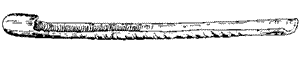
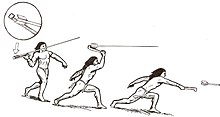
A spear-thrower, spear-throwing lever or atlatl (pronounced [1] or ;[two] Nahuatl ahtlatl [ˈaʔt͡ɬat͡ɬ]) is a tool that uses leverage to achieve greater velocity in sprint or javelin-throwing, and includes a bearing surface which allows the user to store free energy during the throw.
Information technology may consist of a shaft with a cup or a spur at the end that supports and propels the barrel of the spear. It's usually almost as long equally the user's arm or forearm. The user holds the spear-thrower in 1 hand, gripping almost the end uttermost from the cup. The user puts the barrel terminate of the spear, or sprint, in the cup, or grabs the spur with the finish of the spear. The spear is much longer than the thrower. The user holds the spear parallel to the spear-thrower and going in the other management. The user can hold the spear, with the alphabetize and thumb, with the aforementioned hand as the thrower, with the other fingers. The user reaches back with the spear pointed at the target. Then they make an overhand throwing move with the thrower while letting go of the spear with the fingers.[3] [four]
The sprint is thrown by the action of the upper arm and wrist. The throwing arm together with the atlatl acts as a lever. The spear-thrower is a low-mass, fast-moving extension of the throwing arm, increasing the length of the lever. This extra length allows the thrower to impart force to the sprint over a longer distance, thus imparting more than energy and higher speeds.[v]
Common mod brawl throwers (molded plastic arms used for throwing tennis balls for dogs to fetch) apply the aforementioned principle.
A spear-thrower is a long-range weapon and can readily impart to a projectile speeds of over 150 km/h (93 mph).[6]
Spear-throwers appear very early on in human history in several parts of the world, and have survived in use in traditional societies until the nowadays day, as well as existence revived in recent years for sporting purposes. In the United States, the Nahuatl word atlatl is ofttimes used for revived uses of spear-throwers (or the Mayan give-and-take hul'che); in Australia, the Dharug word woomera is used instead.
The ancient Greeks and Romans used a leather thong or loop, known as an ankule or amentum, as a spear-throwing device.[7] The Swiss pointer is a weapon that works similarly to amentum.
Design [edit]

Bannerstone atlatl weight, c. 2000 BC. Archaic peoples; Ohio
Spear-thrower designs may include improvements such as thong loops to fit the fingers, the apply of flexible shafts or stone balance weights. Dart shafts can be fabricated thinner and highly flexible for added power and range, the fletching can be spiralized to add together spin to the dart making it more than stable and accurate. Darts resemble big arrows or small spears and are typically from 1.2 to two.7 m (4 to 9 ft) in length and 9 to sixteen mm (3/viii" to 5/8") in diameter.
Another of import improvement to the spear-thrower's design was the introduction of a small weight (betwixt threescore and lxxx grams) strapped to its midsection. Some atlatlists maintain that stone weights add mass to the shaft of the device, causing resistance to dispatch when swung and resulting in a more forceful and authentic launch of the sprint. Others claim that spear-thrower weights add but stability to a bandage, resulting in greater accuracy.[ citation needed ]
Based on previous work done by William S. Webb, William R. Perkins[viii] claims that spear-thrower weights, ordinarily called "bannerstones", and characterized by a centered pigsty in a symmetrically shaped carved or ground stone, shaped wide and apartment with a drilled hole and thus a petty like a big wingnut, are an improvement to the design that created a silencing issue when swung. The use of the device would reduce the telltale "zip" of a swung atlatl to a more than subtle "woof" sound that did not travel every bit far and was less likely to warning prey. Robert Berg'due south theory is that the bannerstone was carried by hunters as a spindle weight to produce string from natural fibers gathered while hunting, for the purpose of tying on fletching and hafting rock or os points.[9]
Woomera [edit]
The woomera design is distinctly different from well-nigh other spear-throwers, in that it has a curved, hollow shape, which allows for it to be used for other purposes (in some cases) such as carrying food.
Artistic designs [edit]
Several Stone Historic period spear-throwers (unremarkably now incomplete) are busy with carvings of animals: the British Museum has a mammoth, and there is a hyena in France. Many pieces of decorated bone may accept belonged to Bâtons de commandement.[ citation needed ]
The Aztec atlatl was often decorated with snake designs and feathers,[10] potentially evocative of its association with Ehecatl, the Aztec wind deity.[11]
History [edit]

Wooden darts were known at to the lowest degree since the Heart Paleolithic (Schöningen, Torralba, Clacton-on-Sea and Kalambo Falls). While the spear-thrower is capable of casting a dart well over one hundred meters, it is most accurately used at distances of twenty meters or less. The spearthrower is believed to take been in use by Homo sapiens since the Upper Paleolithic (around 30,000 years agone).[12] Well-nigh stratified European finds come from the Magdalenian (belatedly upper Palaeolithic). In this flow, elaborate pieces, often in the form of animals, are common. The earliest secure information concerning atlatls accept come from several caves in France dating to the Upper Paleolithic, nigh 21,000 to 17,000 years ago. The earliest known example is a 17,500-year-old Solutrean atlatl fabricated of reindeer antler, found at Combe Saunière (Dordogne), France.[13] It is possible that the atlatl was invented earlier than this, as Mungo Man from 42 000 BP displays arthritis in his right elbow, a pathology referred to today as the "Atlatl elbow," resulting from many years of forceful torsion from using an atlatl.[14] At nowadays at that place is no show for the use of atlatls in Africa. Peoples such as the Maasai and Khoi San throw spears without any aids, just its employ in hunting is express in comparing to the spear thrower since the animal must be very close and already immobile.
During the Ice Historic period, the atlatl was used past humans to hunt Megafauna. Ice Age Megafauna offered a large food supply when other game was limited, and the atlatl gave more than power to pierce their thicker skin. In this time period, atlatls were usually made of wood or bone. Improvements fabricated to spears' edge made it more than efficient as well.[15]
In Europe, the spear-thrower was supplemented past the bow and arrow in the Epi-Paleolithic. Along with improved ease of utilise, the bow offered the advantage that the majority of elastic energy is stored in the throwing device, rather than the projectile; arrow shafts tin therefore be much smaller, and accept looser tolerances for spring constant and weight distribution than atlatl darts. This immune for more forgiving flint knapping: sprint heads designed for a particular spear thrower tend to differ in mass past only a few percent. By the Atomic number 26 Age, the amentum, a strap fastened to the shaft, was the standard European mechanism for throwing lighter javelins. The amentum gives not only range, merely also spin to the projectile.[16]

Ceremonial spear thrower, Peru, 0–300 A.D., Lombards Museum
The spear-thrower was used past early Americans equally well. Information technology may have been introduced to America during the immigration beyond the Bering Land Span,[ citation needed ] and despite the afterwards introduction of the bow and arrow,[ commendation needed ] atlatl use was widespread at the time of commencement European contact.[ commendation needed ] Atlatls are represented in the art of multiple pre-Columbian cultures, including the Basketmaker culture in the American Southwest, Maya in the Yucatán Peninsula, and Moche in the Andes of Due south America. Atlatls were peculiarly prominent in the iconography of the warriors of the Teotihuacan culture of Key Mexico. A ruler from Teotihucan named Spearthrower Owl is an important figure described in Mayan stelae. Complete wooden spear-throwers have been found on dry sites in the western United States and in waterlogged environments in Florida and Washington. Several Amazonian tribes likewise used the atlatl for fishing and hunting. Some fifty-fifty preferred this weapon over the bow and arrow, and used it not only in combat but as well in sports competitions. Such was the case with the Tarairiu, a Tapuya tribe of migratory foragers and raiders inhabiting the forested mountains and highland savannahs of Rio Grande practice Norte in mid-17th-century Brazil. Anthropologist Harald Prins offers the following description:
Equally referenced to earlier, the spear-thrower was an important part of life, hunting, and religion in the ancient Andes. The earliest known spear-thrower of the South Americas had a proximal handle piece and is ordinarily referred to as an estólica in Spanish references to indigenous Andean culture[ citation needed ]. Estólica and atlatl are therefore synonymous terms. The estólica" is best known archaeologically from Nazca culture and the Inca culture, just the earliest examples are known from associations with Chinchorro mummies.[17] The estólica is also known from Moche culture, including detailed respresentations on painted pottery, and in representations on textiles of the Wari culture[eighteen]
The Andean estólica had a wooden body with a hook that was fabricated of stone or metal. These hooks have been institute at multiple highland sites including Cerro Baúl, a site of the Wari civilisation. In the Andes, the tips of darts were often capped with metal. Arrow points commonly had the same advent as these Andean tips[ commendation needed ]. The length of a common estòlica was near 50 cm. Estólica handles were commonly carved and modeled to represent real world accounts like animals and deities.[19]
Examples of estòlicas with no handle pieces have been interpreted as children'southward toys[ citation needed ]. Archaeologists found busy examples in the Moche culture burial of the Lady of Cao at El Brujo in the Chicama valley. At her feet was a group of twenty-3 atlatls with handle pieces that depicted birds. These "theatrical" estòlicas are different from normal weapons. They are much longer (fourscore-100 cm) than the regular examples (fifty-60cm). John Whittaker and Kathryn Kamp believe that they might have been role of a anniversary before the burial or symbolic references to bespeak that the royal adult female in the burial had been a warrior.[ citation needed ]
Estólicas are depicted along with maces, clubs, and shields on Moche vessels that illustrate warfare.[20] The atlatl appears in the artwork of Chavín de Huantar, such equally on the Blackness and White Portal.[ citation needed ]
The atlatl, as used by these Tarairiu warriors, was unique in shape. About 88 cm (35 in) long and three to 4.5 cm (1+ 1⁄4 to ane+ 3⁄iv in) wide, this spear thrower was a tapering piece of wood carved of brown hard-wood. Well-polished, information technology was shaped with a semi-circular outer half and had a deep groove hollowed out to receive the end of the javelin, which could be engaged past a horizontal wooden peg or spur lashed with a cotton thread to the proximal and narrower end of the throwing board, where a few scarlet parrot feathers were tied for decoration. [Their] darts or javelins ... were probably made of a two-meter long wooden cane with a stone or long and serrated hard-forest signal, sometimes tipped with poison. Equipped with their uniquely grooved atlatl, they could bung their long darts from a great distance with accuracy, speed, and such deadly strength that these easily pierced through the protective armor of the Portuguese or whatever other enemy.[21]
Among the Tlingit of Southeast Alaska, approximately one dozen very old elaborately carved specimens they call "shee áan" (sitting on a branch) remain in museum collections[22] and individual collections, 1 having sold at sale for more than $100,000.[ commendation needed ]
In September 1997, an atlatl dart fragment, carbon dated to 4360 ± fifty 14C yr BP (TO 6870), was establish in an ice patch on mountain Thandlät, the first of the southern Yukon Ice Patches to be studied.[23] [24] [25] : 363 [26] : 2
The people of New Republic of guinea and Aboriginal people in Commonwealth of australia also apply spear-throwers. In the mid Holocene,[27] Aboriginal people in Australia developed spear-throwers, known as woomeras.[28] [29]
As well as its applied employ as a hunting weapon, it may likewise accept had social effects. John Whittaker, an anthropologist at Grinnell Higher, Iowa, suggests the device was a social equalizer in that it requires skill rather than musculus power alone. Thus women and children would have been able to participate in hunting.[half-dozen]
Whittaker said the stone-tipped projectiles from the Aztec atlatl were not powerful enough to penetrate Castilian steel plate armor, simply they were strong enough to penetrate the mail, leather and cotton armor that most Castilian soldiers wore.[10] Whittaker said the Aztecs started their battles with atlatl darts followed with melee combat using the macuahuitl.[10]
Bâtons de commandement [edit]
Another blazon of Stone Age artefact that is sometimes excavated is the bâton de commandement . These are shorter, normally less than one foot long, and made of antler, with a hole drilled through them. When first found in the nineteenth century, they were interpreted by French archaeologists to be symbols of authority, like a modern Field Marshal'south baton, and so named bâtons de commandement ("batons of command"). Though debate over their role continues, tests with replicas have found them, when used with a cord, very effective aids to spear or dart throwing.[thirty] Some other theory is that they were "arrow-straighteners".[ citation needed ]
Bian Jian ("Spear sling") [edit]
Bian Jian (鞭箭, lit. 'Whip arrow') is a unique spear-thrower that was used during Vocal period. It can be described every bit a very long staff sling that throws a spear-sized dart instead of a stone-like projectile. It requires 2 operators unlike other spear-throwers. Information technology should not be confused with some other Bian Jian (邊箭).
Mod times [edit]

The thrower is checking to run into that the sprint has been correctly located on the spur of the spear-thrower; adjacent she will turn her head in the other direction, aim and throw

In modern times, some people take resurrected the dart thrower for sports, oft using the term atlatl, throwing either for distance and/or for accurateness. The Earth Atlatl Clan was formed in 1987[31] to promote the atlatl.[32] Throws of almost 260 m (850 ft) have been recorded.[33] Colleges reported to field teams in this event include Grinnell College in Iowa, Franklin Pierce University in New Hampshire, Alfred University in New York, and the Academy of Vermont.[34]
Atlatls are sometimes used in modern times for hunting. In the U.South., the Pennsylvania Game Commission has given preliminary approval for legalization of the atlatl for hunting certain animals.[35] The animals that would be allowed to atlatl hunters have even so to be adamant, but particular consideration has been given to deer. Currently, Alabama allows the atlatl for deer hunting, while a handful of other states list the device as legal for rough fish (those not sought for sport or nutrient), some game birds and non-game mammals.[36] Starting in 2007, Missouri allowed employ of the atlatl for hunting wild animals (excluding deer and turkey), and starting in 2010, also allowed deer hunting during the firearms portion of the deer flavor (except the muzzleloader portion).[37] [38] Starting in 2012, Missouri allowed the use of atlatls during the fall archery deer and turkey hunting seasons and, starting in 2014, allowed the apply of atlatls during the spring turkey hunting flavour as well.[39] Missouri also allows apply of the atlatl for fishing, with some restrictions (like to the restrictions for spearfishing and bowfishing).[40] The Nebraska Game and Parks Committee allows the use of atlatls for the taking of deer as of 2013[update].[41]
The woomera is still used today by some Ancient people for hunting in Australia[ commendation needed ]. Yup'ik Eskimo hunters yet utilize the atlatl, known locally every bit "nuqaq" (nook-ak), in villages near the mouth of the Yukon River for seal hunting.[ citation needed ]
Competitions [edit]
At that place are numerous atlatl competitions held every twelvemonth, with spears and spear-throwers built using both ancient and modern materials. Events are often held at parks, such as Letchworth State Park in New York, Cahokia Mounds State Historic Site in Illinois, or Valley of Fire State Park in Nevada.[6] Atlatl associations around the world[42] host a number of local atlatl competitions. Chimney Point Land Historic Site in Addison, Vermont hosts the annual Northeast Open Atlatl Championship. In 2009, the Fourteenth Annual Open Atlatl Championship was held on Saturday and Sunday, September nineteen and 20. On the Friday before the Championship, a workshop was held to teach mod and traditional techniques of atlatl and dart structure, flintstone knapping, hafting stone points, and cordage making.[43] Competitions may be held in conjunction with other events, such as the Ohio Pawpaw Festival,[44] or at the Bois D'Arc Primitive Skills Gathering and Knap-in, held every September in southern Missouri.[45]
Atlatl events commonly include the International Standard Accuracy Contest (ISAC), in which contestants throw ten times at a bull'due south-eye target.[46] Other contests involving dissimilar distances or terrain may also be included, ordinarily testing the atlatlist'due south accurateness rather than distance throwing.
Popular civilisation [edit]
In the sixth episode of the fourth flavour of the goggle box contest Top Shot, the elimination circular consisted of two contestants using the atlatl at ranges of xxx, 45 and 60 feet.
An atlatl was the weapon of pick of a serial killer in the 2020 action-thriller The Silencing.[47]
Lydia Demarek, a character in the popular fantasy novel series Brotherband, owns and ofttimes uses an atlatl.
Run across likewise [edit]
- Amentum
- Aztec warfare
- Hunter-gatherer societies
- Kestros
- Swiss arrow
- Woomera (spear-thrower)
References [edit]
- ^ "atlatl". Oxford English language Dictionary (Online ed.). Oxford University Printing. (Subscription or participating institution membership required.)
- ^ "atlatl". Dictionary.com Unabridged (Online). n.d.
- ^ Archived at Ghostarchive and the Wayback Machine: "How to Throw an Atlatl and Dart". youtube.com. Retrieved 2021-06-30 .
- ^ Archived at Ghostarchive and the Wayback Machine: "The Atlatl: Near Underrated Stone Age Tool?". youtube.com. Retrieved 2021-06-thirty .
- ^ "Atlatl History and Physics". Tasigh.org. Retrieved 2013-09-21 .
- ^ a b c "Girls on pinnacle". The Economist. April 12, 2008.
- ^ Howard L. Blackmore. (2000) Hunting Weapons: From the Center Ages to the Twentieth Century, page 103 "... the air'.31 A device which enabled all only the heaviest of spears to be cast a respectable distance was the spear thrower. ... It was known to the Greeks equally the ankuli and to Romans as the amentum.3 The spear was rested in the hand and ..."
- ^ "Atlatls & Primitive Technology". Retrieved 2012-08-19 .
- ^ Robert S. Berg (17 June 2005). "Bannerstones And How They Chronicle To The Atlatl". Retrieved 2018-03-08 .
- ^ a b c "Mexicolore". Mexicolore. 2012-12-21. Retrieved 2013-09-21 .
- ^ Mexicolore's folio on the atlatl, and its connection with Ehecatl
- ^ McClellan, James Edward; Dorn, Harold (2006). Science and technology in globe history: an introduction. JHU Printing. p. eleven. ISBN978-0-8018-8360-vi.
- ^ Peregrine, Peter N.; Ember, Melvin (2001). "Europe". Encyclopedia of Prehistory. Vol. 4. Springer. ISBN978-0-306-46258-0.
- ^ "Mungo Lady and Mungo Homo". mungo. n.d. Retrieved November 3, 2018.
- ^ Toler, Pamela D. (xxx October 2012). Flesh: The Story of All of U.s.. Running Press. p. 20. ISBN978-0-7624-4703-ix.
- ^ Gardiner, E. Norman (1907). "Throwing the Javelin". The Journal of Hellenic Studies. 27: 249–273. doi:10.2307/624444. JSTOR 624444.
- ^ Arriaza, Bernardo (1995). Beyond Expiry: The Chinchorro Mummies of Ancient Chile. Washington, DC: Smithsonian Institution. ISBN978-1560985129.
- ^ Critchley, Zachary. "The Fine art of the Spearthrower: Agreement the Andean Estólica through Iconography". Retrieved 28 Apr 2021.
- ^ Slater, Donald (2011). "Ability Materialized: The Dart-Thrower as a Pan-Mesoamerican Status Marker". Ancient Mesoamerica. 22 (two): 371–388. doi:10.1017/S0956536111000277. S2CID 162483649. Retrieved 28 April 2021.
- ^ Whittaker, John (2006). "Atlatl Apply on Moche Pottery of Ancient Peru". The Newsletter of the World Atlatl Association, Inc. 19 (3).
- ^ Prins, Harald East.Fifty. (2010). "The Atlatl equally Gainsay Weapon in 17th-Century Amazonia: Tapuya Indian Warriors in Dutch Colonial Brazil" (PDF). The Atlatl. 23 (ii): 1–3. Archived from the original (PDF) on 2012-02-29. Retrieved 2013-05-08 .
- ^ "Fenimore Art Museum | Atlatl". Collections.fenimoreartmuseum.org. 1992-12-08. Archived from the original on 2013-09-23. Retrieved 2013-09-21 .
- ^ "Traditional Homeland". Kusawa Park Steering Commission. n.d. Archived from the original on 2017-03-29. Retrieved December 2, 2017.
- ^ Kuzyk, K.Westward.; Russell, D.Due east.; Farnell, R.Southward.; Gotthardt, R.One thousand.; Hare, P.G.; Blake, E. (1999). "In pursuit of prehistoric c caribou on Thandlät, southern Yukon" (PDF). Chill. 52 (two): 214–219. doi:10.14430/arctic924.
- ^ de la Cadena, Marisol; Starn, Orin, eds. (September fifteen, 2007). Indigenous Experience Today. Bloomsbury Academic. p. 384. ISBN978-1845205195 . Retrieved December 2, 2017.
- ^ Hare, Greg (2011). The Frozen Past: The Yukon Water ice Patches (PDF) (Study). Authorities of the Yukon. p. 36. ISBN978-ane-55362-509-4 . Retrieved December 2, 2017.
- ^ Laet, Sigfried J. de & International Committee for the New Edition of the History of the Scientific and Cultural Development of Mankind & International Commission for a History of the Scientific and Cultural Development of Mankind. History of mankind (1994). History of humanity. Routledge; Paris : Unesco, London; New York, p.1064
- ^ Palter, John L. "Blueprint and construction of Australian spear-thrower projectiles and manus-thrown spears." Archaeology & Physical Anthropology in Oceania (1977): 161-172. APA
- ^ Cundy, B. J. (1989). Formal variation in Australian spear and spearthrower technology (Vol. 546). British Archaeological Reports Ltd.
- ^ Wescott, David, ed. (1999). Primitive Applied science: A Volume of World Skills. Society of Archaic Applied science, Gibbs Smith. ISBN9780879059118 . Retrieved 2013-09-21 – via Google Books.
- ^ "The World Atlatl Association: About U.s.a.". ten May 2016. Retrieved 2017-02-10 .
- ^ "The World Atlatl Association: Mod sport". 12 May 2016. Retrieved 2017-02-10 .
- ^ "The Atlatl". Flight-toys.com. Retrieved 2009-06-08 .
- ^ "Our Towns: A Higher Squad Takes Aim". Parade.com. 2010-05-thirty. Retrieved 2013-09-21 .
- ^ "Pennsylvania May Allow Hunters Use Prehistoric Weapon". RedOrbit.com. 2005-11-13. Retrieved 2009-06-08 .
- ^ "Spear near in Pennsylvania? from espn.com". Sports.espn.go.com. 2006-06-21. Retrieved 2009-06-08 .
- ^ "2013 Firearms Deer Hunting | Missouri Section of Conservation". Mdc.mo.gov. 2013-09-xv. Archived from the original on 2011-05-21. Retrieved 2013-09-21 .
- ^ Wang, Regina (2010-09-28). "Atlatl makes debut for Missouri deer season". Columbia Missourian. Archived from the original on 2010-x-06. Retrieved 2013-09-21 .
- ^ "Conservation Activity: Meeting of the May 2011 Conservation Committee | Missouri Department of Conservation". Archived from the original on Nov 16, 2012. Retrieved 2011-11-25 .
{{cite web}}: CS1 maint: bot: original URL status unknown (link) - ^ "Missouri Section of Conservation, Wildlife Code: Sport Fishing: Seasons, Methods, Limits" (PDF). Sos.mo.gov. Retrieved 2013-09-21 .
- ^ "Whitetail and Mule Deer Hunting". State of Nebraska. Archived from the original on December 21, 2014. Retrieved December 21, 2014.
- ^ "Atlatl Associations". Thunderbird Atlatl. Retrieved 2013-09-21 .
- ^ [1] Archived September v, 2009, at the Wayback Machine
- ^ "2013 Ohio Pawpaw Festival". Ohiopawpawfest.com. Retrieved 2013-09-21 .
- ^ "Bois D' Arc Primitive Skills Gathering and Knap-in". Retrieved 2013-10-06 .
- ^ "ISAC Rules Package" (PDF). Archived from the original (PDF) on 2017-02-11. Retrieved 2017-02-10 .
- ^ "Atlatl Madness'south Atlatl Darts in a Pic!!! "The Silencing"". July 21, 2020. Retrieved August 13, 2020.
- Garrod, D (1955). "Palaeolithic spear throwers". Proc. Prehist. Soc. 21: 21–35. doi:x.1017/s0079497x00017370.
- Hunter, West. (1992) "Reconstructing a Generic Basket Maker Atlatl", Bulletin of Archaic Technology, No. 4.
- Knecht, H. (1997) Projectile technology, New York, Plenum Press, 408 p. ISBN 0-306-45716-4
- Nuttall, Zelia (1891). The atlatl or spear-thrower of the ancient Mexicans. Cambridge, Massachusetts: Peabody Museum of American Archaeology and Ethnology. OCLC 3536622.
- Perkins, W. (1993) "Atlatl Weights, Function and Classification", Message of Primitive Engineering, No. 5.
- Prins, Harald E.50. (2010). The Atlatl as Combat Weapon in 17th-Century Amazonia: Tapuya Indian Warriors in Dutch Colonial Brazil. The Atlatl, Vol.23, No.two, pp. 1–3. http://waa.basketmakeratlatl.com/wp-content/uploads/2013/02/Tapuya-Atlatl-Article-by-Harald-Prins-25 [ permanent dead link ] May 2010.pdf
- Stodiek, U. (1993) Zur Technik der jungpaläolithischen Speerschleuder (Tübingen).
External links [edit]
 | Wikimedia Commons has media related to Atlatl. |
- Earth Atlatl Association Spider web Site
- Atlatl reference folio
- Graphic of a spear thrower in use.
Source: https://en.wikipedia.org/wiki/Spear-thrower
0 Response to "What Is the State of the Art in Atlatl Development"
Post a Comment