Rokinon Fe14m-c 14mm F28 Ultra Wide Lens Review
Our Verdict
The Rokinon/Samyang 14mm f/2.eight lens is a great style to get an extremely wide field of view without breaking the banking company.
For
- Extremely wide
- Reasonably fast
- Overnice and cheap
Against
- Confronting
- Baloney
- All-manual
- Fixed hood
Extremely wide and extremely inexpensive may sound similar a bit of an insult, simply to photographers, it can exist the Holy Grail. The Rokinon/Samyang 14mm lens is about as wide as you tin go on 1 of the best cameras for astrophotography without fisheye distortion, dropping your aperture lower than f/2.eight, or spending a lot more money, making information technology an enticing lens for astrophotographers and ane of our all-time lenses for astrophotography.
Alongside taking in vast swathes of the night sky with its 115° field of view, a 14mm lens can be used for getting upward really close to things, capturing the inside of rooms, or plumbing equipment the majesty of entire mountains in the frame. It's a specialist focal length, certainly, but appeals to enough niches that having one in your lens collection isn't a complete extravagance. That'southward why we rate it among the all-time lenses for astrophotography right now.
Key specifications
Blazon: Prime number, full-frame compatible
Compatibility: Canon EF (tested), Nikon F, Nikon Z, Sony FE
Focal range: 14mm
Aperture range: f/2.8 - f/22
Thread size: None
Weight: 1.1lb
- Related: DSLR vs Mirrorless Cameras for Astrophotography
Rokinon/Samyang 14mm f/two.8 lens review: Blueprint
- Not besides heavy
- Chip of a strange shape
- Plastic body, metal mount
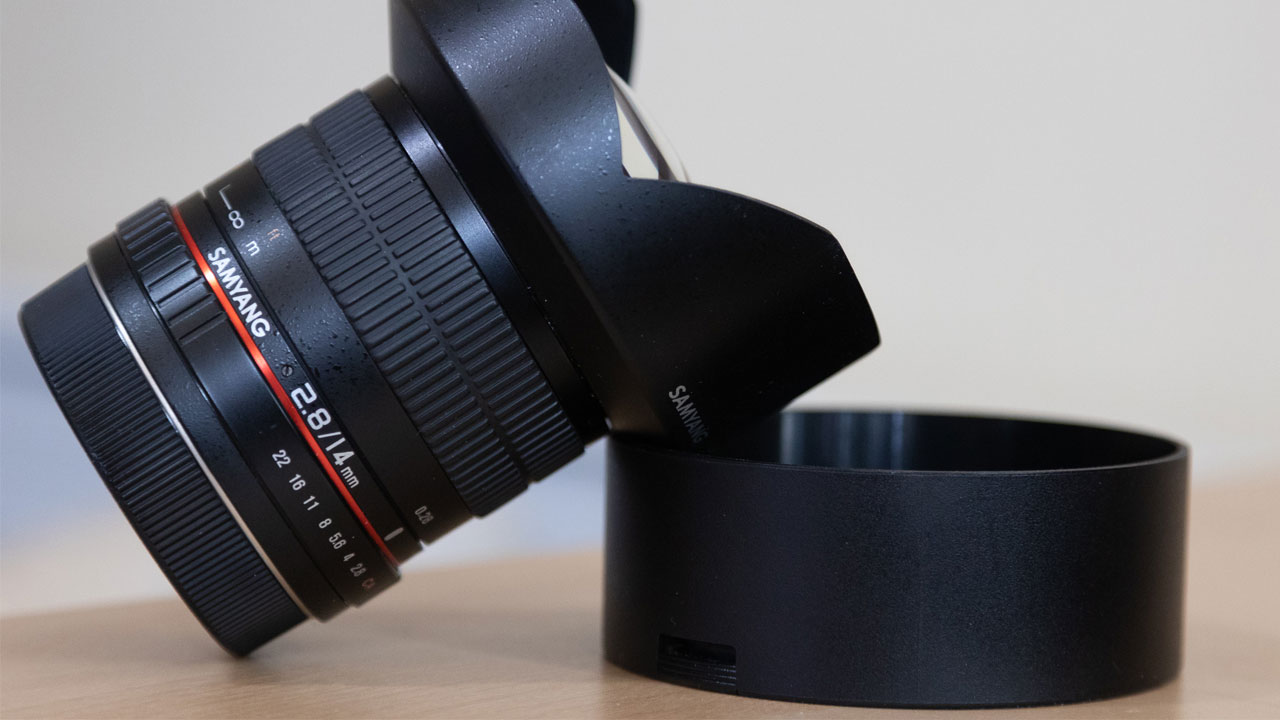
Looked at from the bespeak of view of someone used to more than mod lens releases, the fatty black cylinders marked but by a maker'southward name and focal length, their manual focus ring a slim afterthought that barely breaks their smooth plastic exterior with its grippy pattern, the Samyang 14mm f/2.8 is a curious creature.
Offset, there's the name. This is a Korean-made lens that's sold under a couple of different names. This lens is commonly sold equally Samyang or Rokinon, though the company that owns the names also has Vivitar, Bower, Opteka, and many other brands you lot'll see on inexpensive lenses in its collection. There's no difference between the brands; they're made in the same factory, just named differently. Ours is Samyang branded, then we'll refer to it as that.
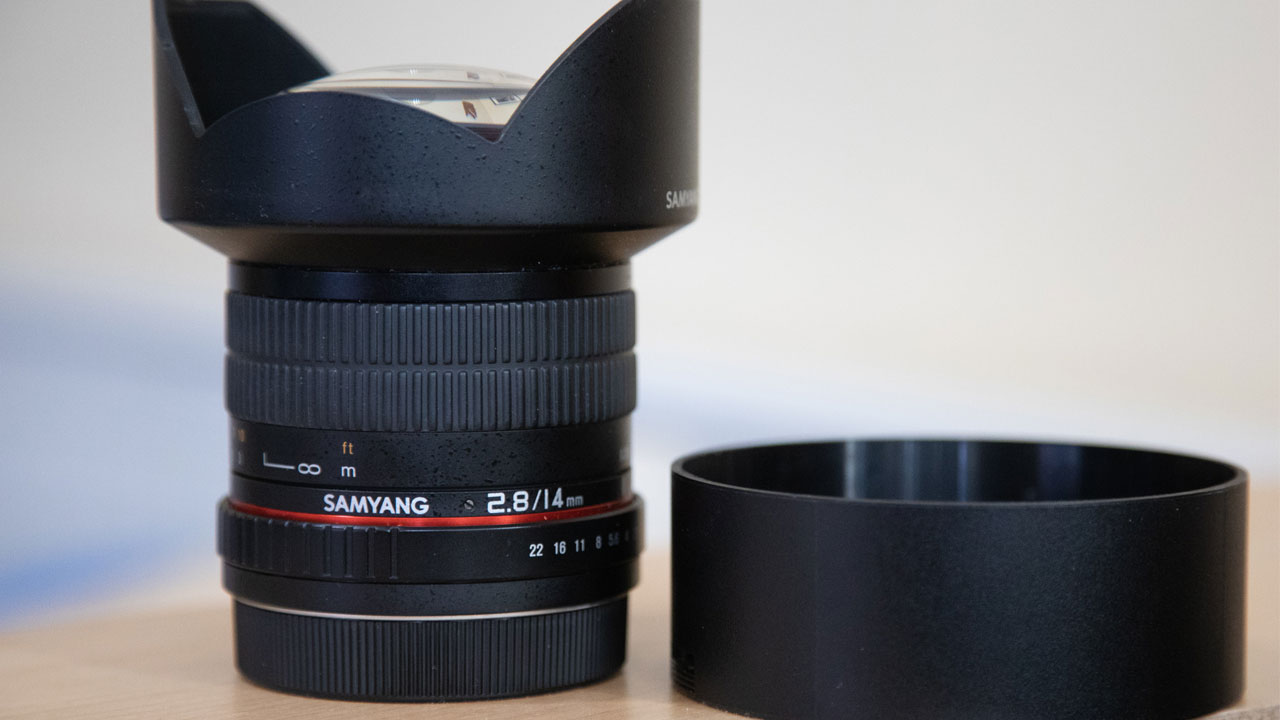
And then at that place'due south the shape. Because information technology'southward a manual-focus prime, there's no demand for autofocus motors or concentric sections of butt, so where it meets the camera information technology appears narrower than many other lenses. At the other end, however, information technology suddenly yawns out into an enormous fixed petal hood that protects the bulbous glass chemical element beneath.
Due to this stock-still hood, the lens cap, which slides downwardly to completely cover it and clicks into place, is besides on the large side. Whereas the caps from most lenses can be slipped easily into a pocket as they are well-nigh flat, you have to take a moment to think nigh where you're going to keep this ane.
The lens is made of a couple of different types of plastic, with the aperture ring noticeably smoother, while the mount is made of metal. It'south decent quality plastic, even so, and the lens feels solid in the hand. Astrophotographers will capeesh the hard end at infinity focus, which makes information technology much easier to keep the stars sharp without having to take your attention away from the camera screen.
- Related: Astrophotography fourth dimension-lapse tips
Rokinon/Samyang 14mm f/2.8 lens review: Operation
Ultrawide lenses, even rectilinear ones like the Rokinon/Samyang 14mm f/2.8 lens, have a noticeable caste of distortion. And while the center of the lens is acceptably precipitous, even wide open the edges and corners leave a certain amount to exist desired. This matters less in terms of astrophotography, as star trailing is more than probable to elongate the stars from point light sources into short lines, just landscape photographers volition definitely find the corners being less precipitous than the centre, while architectural photographers, who worship direct lines, will notice a wobbling bulge in the centre of their images.
Astrophotographers will also need to contend with the pregnant corner shading at f/2.8, something all 14mm lenses suffer from. The distortion and vignetting aren't so bad that the all-time photo editing apps can't take care of them in a single click, nonetheless.
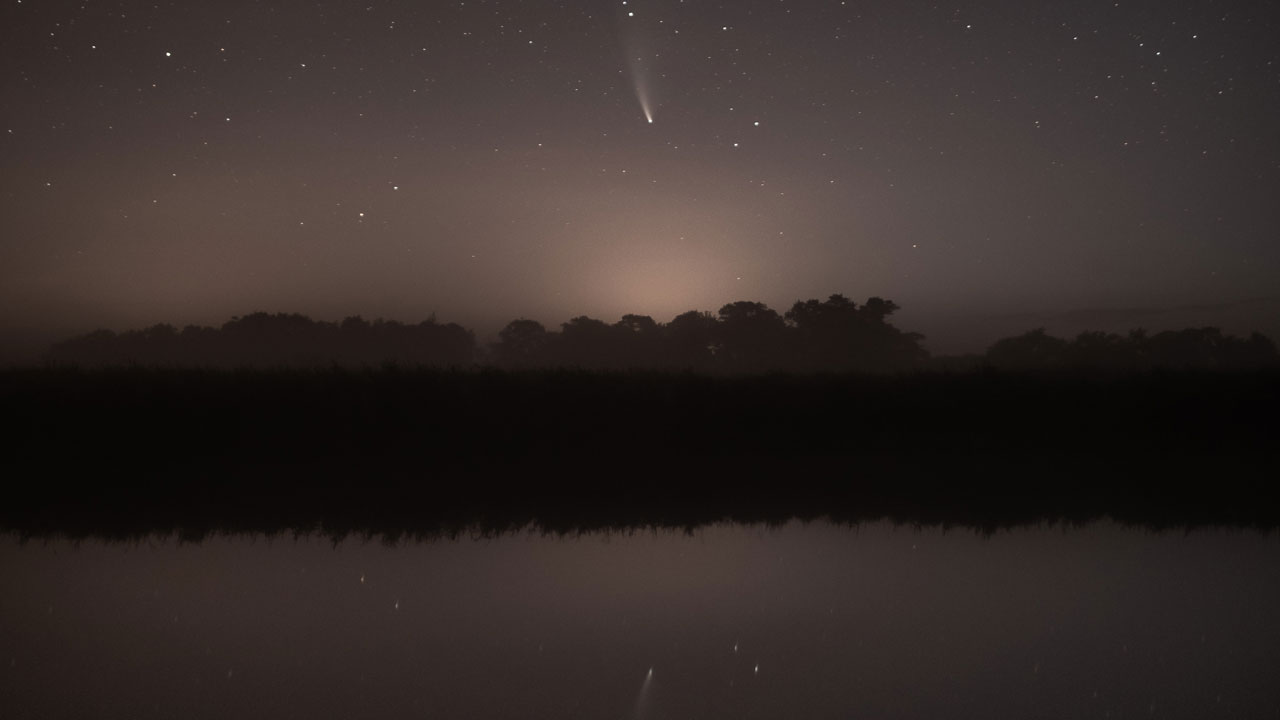
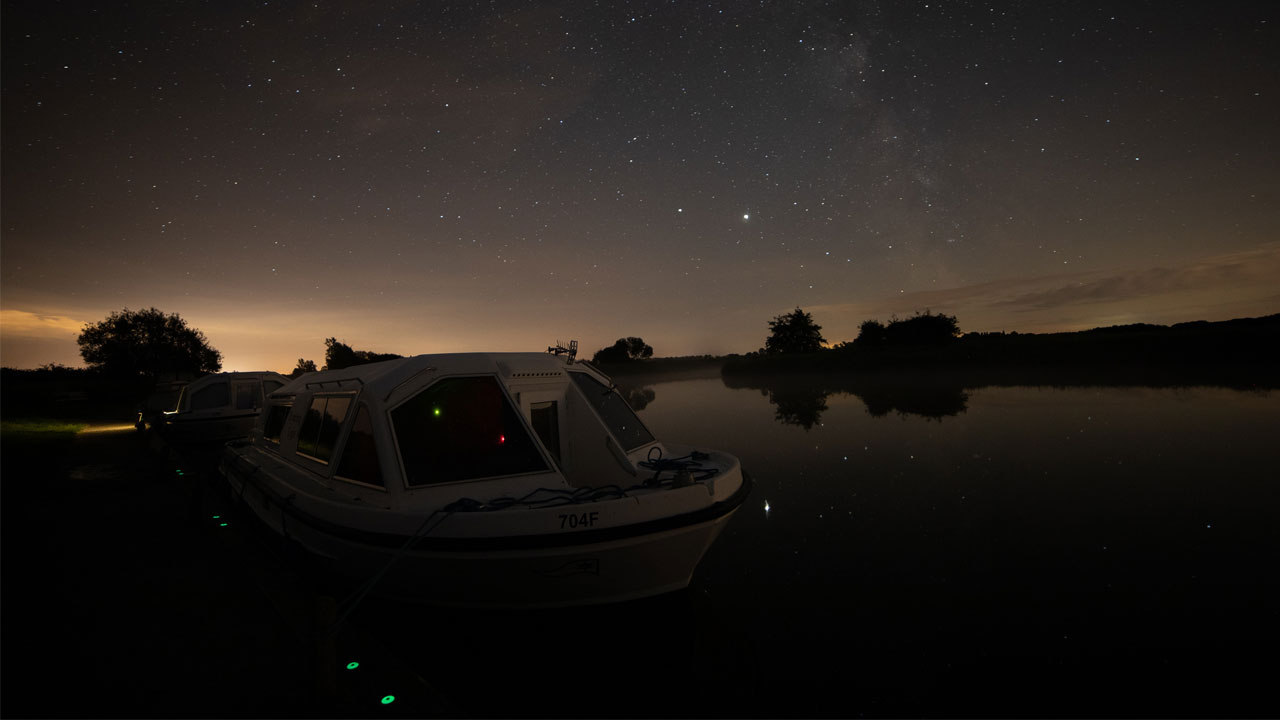
The maximum aperture of f/ii.8 is not especially fast, but then ultrawide lenses with wider apertures are rare. Information technology's certainly improve to take than an f/4 or f/5.half dozen lens, as each boosted stop doubles the amount of calorie-free reaching the sensor, making it easier to pick upwards faint objects without star trailing condign a problem. You can expose for 30 seconds with the Rokinon/Samyang 14mm f/ii.eight lens and become only the slightest trailing in the corner of the image, while stars in the middle remain as points. Dropping to 20 seconds improves matters. If shooting star trails, you lot'll therefore need to stack a lot of 30-second frames to get the total outcome, so wait to go out your camera outside for several hours.
On top of this, there are the usual issues with ultrawide lenses. Place a subject close to the Rokinon/Samyang 14mm f/2.viii lens, and things like their nose will appear elongated. Figures too shut to the edge volition be stretched, and the whole image will take on an elongated, surreal look. This isn't a lens for serious, frame-filling portraiture, but information technology tin be used to place a subject in context every bit a smaller part of a bigger film, the curt focal length meaning you don't need to stand too far away to manage it.
The Rokinon/Samyang 14mm f/2.8 lens can as well be challenging to use every bit every aspect of it is manual. Anyone who used a movie SLR before the advent of autofocus and camera-controlled aperture will find the sometime skills coming back, though. Put your camera in Aperture Priority style, gear up the discontinuity on the lens' band (even at f/2.8, depth of field is considerable) then focus, or set hyperfocal altitude. Only then are you lot ready to take a picture (an AF version is available in some mounts, but doubles the price). On a bright day, stopping down to f/8 might be all you need to exercise, but for astro piece of work y'all're going to desire to be broad open at f/2.8 to make the most of the available light, and then using your photographic camera'south screen to zoom in and make sure the stars are equally abrupt as possible is the key to success.


Should yous buy the Rokinon/Samyang 14mm f/2.eight lens?
If you lot're looking for an inexpensive (price is relative, and camera lens prices can be middle-wateringly loftier) ultrawide lens for astrophotography or mural/architecture utilize, and then there's very little else on the market to touch the Rokinon/Samyang 14mm f/2.eight lens. Anyone who wants to get started with photographing the night sky will capeesh its f/2.8 aperture and ability to fit enormous areas of the cosmos into one frame.
Information technology has its downsides, only things like baloney tin can be stock-still in post-processing, and clever composition can reduce the negative effects of vignetting and soft corners.
This may look similar a specialist lens, but if you want to starting time shooting nighttime-sky images, it'south a great entry bespeak for anyone with a full-frame DSLR.
If this product isn't for you
With the same focal length as the Rokinon/Samyang 14mm f/2.viii lens, and an fifty-fifty wider aperture to let in even more than of that lovely starlight, the Sigma 14mm F1.viii DG HSM Fine art lens adds autofocus but volition prepare you dorsum three or four times as much equally the Samyang.
The Rokinon/Samyang 24mm f/one.4 is another manual lens, but with a light-gobbling aperture ii stops faster than the Rokinon/Samyang 14mm f/two.8 lens. This lens is not equally wide, but is still a neat choice for the night sky, and has all sorts of other applications too. It doesn't misconstrue as much, and its corners are sharper than the Samyang 14mm, though it's slightly more expensive.
Join our Space Forums to proceed talking space on the latest missions, dark sky and more! And if you lot have a news tip, correction or comment, let u.s.a. know at: community@infinite.com.
Source: https://www.space.com/rokinon-samyang-14mm-f2.8-lens-review
0 Response to "Rokinon Fe14m-c 14mm F28 Ultra Wide Lens Review"
Post a Comment